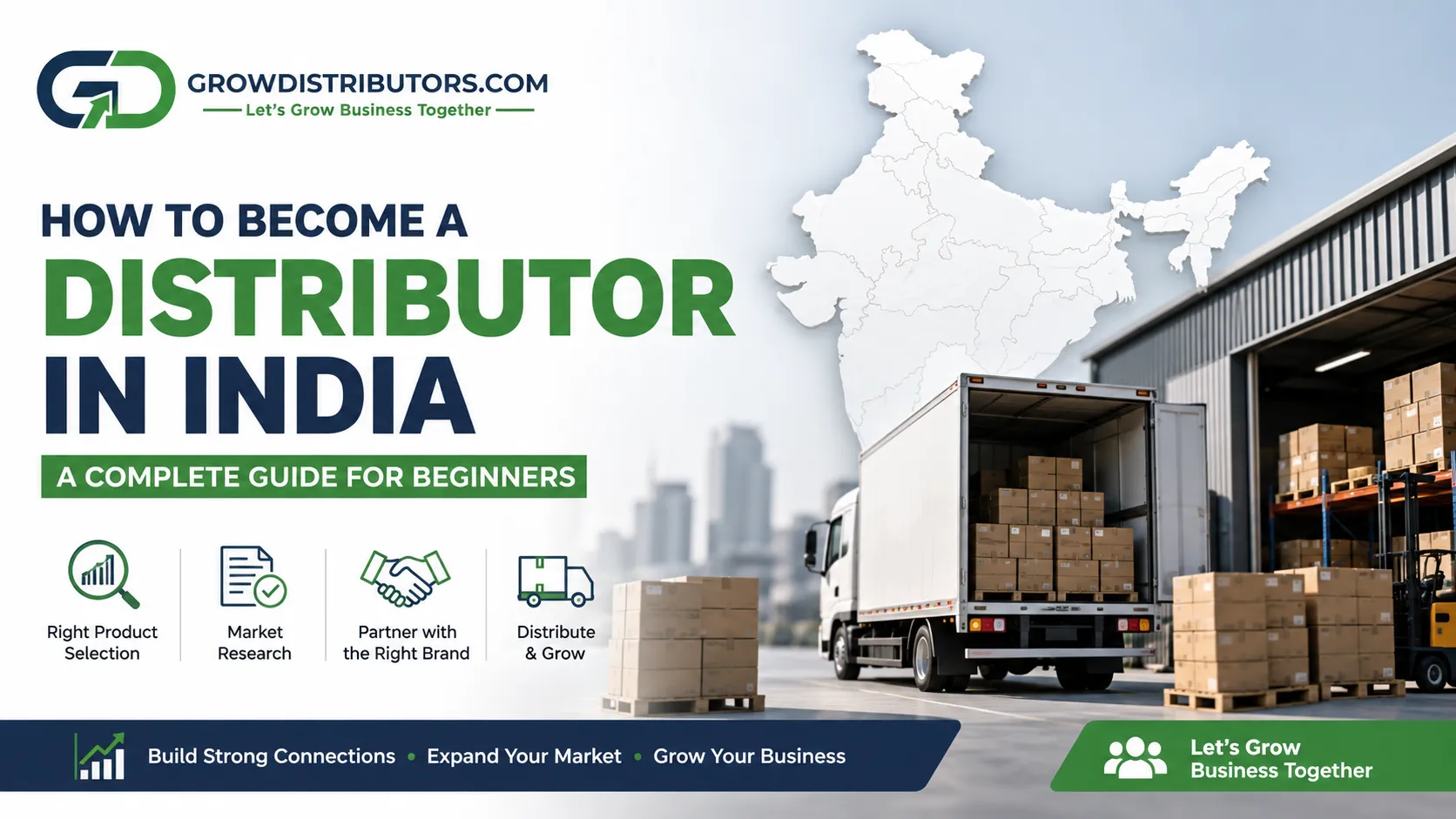
How to Become a Distributor in India: A Complete Guide for Beginners
How to Become a Distributor in India: A Complete Guide for Beginners
Becoming a distributor can be an interesting way to enter the B2B business world without manufacturing a product yourself. Instead of creating a brand from scratch, you work with an established manufacturer or brand and help take its products into a specific market.
But becoming a distributor is not simply about buying products and selling them.
You need to understand the market, choose the right product, evaluate the manufacturer, arrange working capital and build relationships with retailers or other businesses.
If you are researching became a distributor opportunities or wondering how the distribution business actually works, this guide will help you understand the complete process.
What Does a Distributor Do?
A distributor acts as a link between manufacturers and the market.
A typical supply chain may look like:
Manufacturer → Distributor → Dealer/Wholesaler → Retailer → Customer
The exact structure can vary depending on the industry.
A distributor may purchase products from a manufacturer and then supply them to retailers, dealers, wholesalers, or other business customers within an agreed territory.
Typical distributor responsibilities include:
- Purchasing inventory
- Managing stock
- Maintaining a warehouse
- Developing retailer relationships
- Managing orders
- Coordinating deliveries
- Expanding product availability
- Generating repeat sales
- Supporting local product promotion
This is why manufacturers often search for a distributor needed in a particular city, district or state.
Why Do People Become Distributors?
There are several reasons entrepreneurs explore distribution.
One of the biggest advantages is that you don't necessarily need to develop your own product.
Instead, you can partner with a manufacturer that already has the following:
- A product
- Manufacturing capability
- Packaging
- Brand identity
- Product knowledge
Your focus becomes getting the product into the market.
For someone with good local business connections, retailer relationships, or sales experience, distribution can be a practical business model to explore.
However, it should still be treated like a proper business rather than a passive investment.
How to Become a Distributor in India
If you want to become a distributor, follow a structured process rather than choosing the first opportunity you see.
1. Select a Product Category
Start by deciding which category you understand or have access to.
Popular distribution categories include:
FMCG
Packaged food, beverages, snacks, household products and personal care.
Agriculture & Farming
Agricultural tools, equipment, irrigation-related products, and farming supplies.
Health & Personal Care
Skincare, hygiene, cosmetics and other personal-care products.
Ayurvedic Products
Herbal and Ayurvedic products can be distributed through suitable retail and business networks.
Home Care & Cleaning
Cleaning products, detergents, and household supplies.
Apparel & Fashion
Clothing, accessories, and fashion-related products.
Electronics & Industrial Products
Electrical products, equipment, machinery, and industrial supplies.
Choosing one category initially can make market research and sales management easier.
2. Research Market Demand
A common mistake beginners make is choosing a product because it has an attractive margin.
Margin matters, but demand matters more.
Before accepting an opportunity, ask:
- Who will buy the product?
- How frequently will they purchase it?
- Who are the competitors?
- What price are customers already paying?
- How many retailers could sell the product?
- Is there a gap in the local market?
For example, a product with a 30% margin may look attractive, but if retailers don't want it, that margin doesn't mean much.
3. Calculate Your Investment
There is no single investment amount for becoming a distributor.
It depends on:
- Product category
- Minimum order quantity
- Territory
- Warehouse requirements
- Manufacturer terms
- Inventory requirements
- Transportation
- Staff
- Working capital
Your calculation should include both the initial investment and ongoing expenses.
For example:
Initial inventory + warehouse + transportation + staff + working capital = practical capital requirement
Don't use your entire available capital for inventory. Keeping sufficient working capital is important for day-to-day operations.
4. Find Manufacturers Looking for Distributors
Once you know your preferred category and market, start looking for manufacturers.
You can find opportunities through:
- Manufacturer websites
- Trade exhibitions
- Business referrals
- Industry associations
- B2B marketplaces
- Distribution platforms
- Existing business networks
If a company has distributors required for new products, it may advertise its requirements through B2B platforms and business networks.
Platforms such as GrowDistributors can help manufacturers and brands showcase distribution requirements while allowing entrepreneurs to explore potential distribution opportunities.
5. Evaluate the Manufacturer
Never choose a manufacturer solely because the company offers a high margin.
Research:
- Company background
- Product quality
- Manufacturing capacity
- Existing market presence
- Product demand
- Customer feedback
- Distribution network
- Marketing support
Also ask how the manufacturer handles product shortages, damaged stock, returns and promotional schemes.
A distributor depends heavily on the manufacturer for consistent product supply.
6. Understand the Territory
Territory is another important consideration.
A manufacturer may offer distribution rights for:
- A city
- District
- Multiple districts
- State
- Region
If exclusivity is offered, understand exactly what it means.
Ask:
Can another distributor be appointed in the same territory?
Can the manufacturer sell directly to retailers?
What happens if sales targets are not achieved?
These details should ideally be clearly mentioned in the agreement.
7. Understand Your Distributor Margin
Suppose you purchase a product for ₹80 and sell it for ₹100.
Your gross margin is ₹20.
But your actual profit isn't automatically ₹20.
You may have:
- Delivery expenses
- Warehouse costs
- Employee salaries
- Fuel expenses
- Sales expenses
- Damaged stock
- Credit-related costs
Therefore, calculate net profitability, not just product margin.
8. Build a Retailer Network
A distributor becomes stronger when it has a reliable customer network.
Start identifying potential:
- Retailers
- Dealers
- Wholesalers
- Supermarkets
- Specialty stores
- Institutional buyers
Your goal should be to create repeat sales rather than relying on one-time orders.
Good retailer relationships can become one of the most valuable assets of a distribution business.
What Makes a Good Distributor?
Manufacturers generally look for partners who can actually develop the market.
Useful capabilities include:
- Local market knowledge
- Retailer relationships
- Financial capacity
- Storage facilities
- Sales team
- Transportation
- Product-category experience
- Professional communication
You don't necessarily need a huge organization to start, but you need a realistic plan for handling the territory.
Common Mistakes New Distributors Should Avoid
Choosing a Product Only Because of High Margins
A high margin doesn't guarantee high sales.
Buying Excessive Inventory
Start according to realistic market demand.
Ignoring Cash Flow
You may have profitable sales but still face cash-flow problems if customers take too long to pay.
Not Researching Competition
Understand the brands already operating in your market.
Ignoring the Agreement
Always understand territory, targets, margins, payment terms and return policies.
Frequently Asked Questions
How can I become a distributor in India?
Choose a product category, research market demand, identify suitable manufacturers, evaluate investment and margins, and negotiate distribution terms before starting.
How much money is required to become a distributor?
There is no fixed amount. The investment depends on the product, minimum order quantity, territory, inventory and operating requirements.
What products are good for distribution?
FMCG, agriculture, personal care, home care, apparel, electronics and industrial products can all use distribution networks. The best category depends on local demand and your capabilities.
How can I find manufacturers looking for distributors?
You can search manufacturer websites, trade exhibitions, business networks and B2B platforms such as GrowDistributors.
Is distribution a passive business?
Generally, no. Successful distribution usually requires sales, inventory management, retailer relationships, logistics and regular market development.
Final Thoughts
If you are thinking about became a distributor opportunities, don't rush into the first business proposal you find.
Start with the market.
Understand the product, calculate your investment, research the manufacturer, and determine whether you can realistically build sales in your territory.
Distribution can become a strong B2B business when the right product, manufacturer, and market come together.